The choice starts with use
A cabinet front, artwork, hotel interior and retail display face different loads. Scratch resistance, fingerprints, moisture, cleaning products, light and repairability can matter more than initial appearance. We therefore define performance first, then select material, technique and coating build.
Choose the right finish for your project
Choosing one finishing material over another is the first decision in defining the character and protection you want to give the project.
Opaque finish
From top left: ultra-matt · high gloss · structured · soft-touch
Lacquer gives an even, repeatable colour from ultra-matt to high gloss. Texture systems add fine or pronounced grain. Soft-touch systems feel warm and velvety but must suit contact, cleaning and wear.
Transparent finish
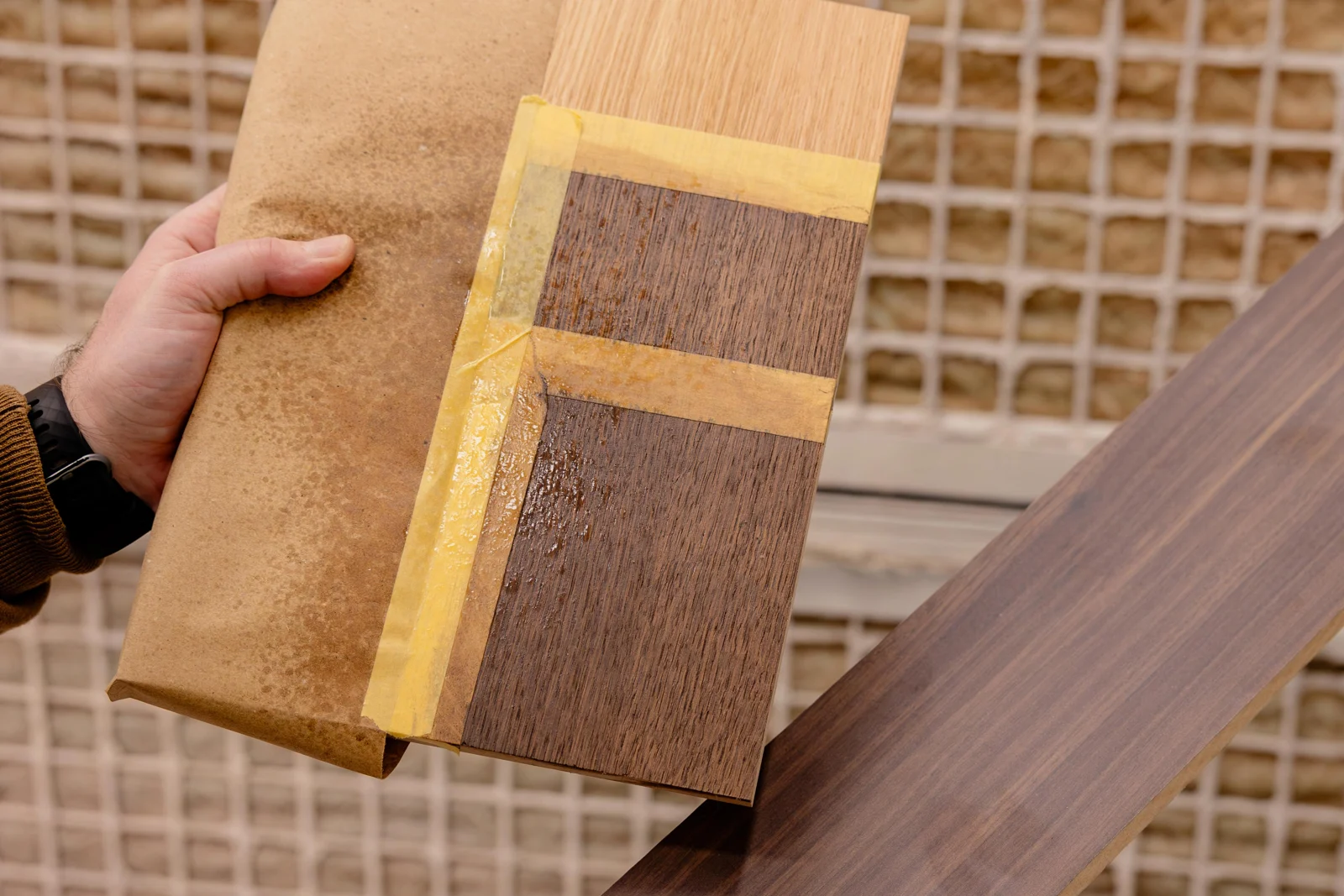
When grain and natural depth should remain visible. Oil, stain, clear coat and transparent lacquer determine colour, gloss, film protection and maintenance.
Metallic and Vulkan
Metallic lacquer offers an efficient repeatable effect. Vulkan creates a seamless real-metal skin, including over relief and complex forms. Metal powders, specialist application, sanding, patination, oxidation and polishing make it material- and labour-intensive, and therefore exclusive.
Tactile or decorative
From top left: trowelled · patinated · brushed relief · crackled
Trowelled textures, brush marks, patinas and effects create relief and a hand-worked character. Variation should be deliberate and defined against a reference.
Species and veneer selection control colour, grain and contrast. Porosity affects absorption and blotching. Glue residue, repairs and sand-through may become more visible. Sanding determines both stain uniformity and the touch and clarity of oil, clear coat or transparent lacquer.
| Material | Choose it when | Colour, gloss and protection | Consideration |
|---|---|---|---|
| Oil | A natural, open and repairable feel takes priority. | Usually deepens colour, stays matt to soft satin and forms little film. | Requires correct saturation, cure and periodic maintenance. |
| Stain | The wood should stay visible but take on another tone. | Colours the fibre but generally provides insufficient final protection alone. | Variable absorption can blotch; oil, clear coat or transparent lacquer usually follows. |
| Clear coat | A transparent film with good use and cleaning resistance is needed. | Matt to gloss, neutral or slightly warming depending on the system. | Build and pore filling affect touch and how natural the wood remains. |
| Transparent lacquer | A controlled transparent or translucent colour is required within a professional coating build. | Broad control over colour, gloss and protection. | Clear-coat and lacquer terminology overlaps; system and performance matter more than the label. |
Gloss level also changes colour perception, scratch visibility, maintenance and the way surface irregularities read.
Which application method is appropriate?
Spraying, trowelling, brushing or powder coating? Each technique creates a different surface, requires different preparation and/or suits different substrates and volumes.
| Technique | Strengths | Considerations |
|---|---|---|
| Sprayed lacquer | Even or textured, repeatable and available in many colours, gloss levels and systems. | A well-equipped spray booth with extraction, filtration and process control is indispensable. |
| Brushed finish | An expressive brushed finish for objects, textured surfaces, small areas and touch-ups. | Less uniform and harder to reproduce identically in series. |
| Trowelled finish | Depth, tactility, structure and seamless crafted effects. | Labour-intensive; variation is often part of the desired result. |
| Powder coating | Robust, efficient and low-solvent in suitable production conditions. | Substrate, conductivity, oven, form and volume require assessment. Set-up is costly and mainly attractive for series production. |
Morvena focuses primarily on bespoke work and complex assignments. We do not offer powder coating in our own workshop; where a project calls for it, we coordinate it with specialist partners.
Laminating and edge banding
Morvena laminates sheet material in its own workshop and can finish exposed edges with suitable edge banding. This allows us to coordinate the substrate, decor, adhesive bond, edge finish and any lacquered parts as one coherent whole. The right construction depends on the sheet material, application, dimensions, load and required detailing.
Other materials and techniques?
Hardwax oil, wax, soap and lye, mineral systems, metal leaf, special patinas and technical coatings may also fit. See When a standard finish is not enough.
Sustainability is more than product type
A sustainable choice combines service life, efficient material use, repairability and a process suited to the substrate. Waterborne or low-emission systems are valuable where they meet performance needs.
A sample where it adds value
Where colour, transparency, texture, effect or variation is critical, a representative sample can align expectations.